China has one of the most complete textile and garment supply chains in the world.
However, many overseas buyers sourcing clothing from China for the first time have a common misunderstanding:
They assume garment factories across China are more or less the same.
In reality, they are not.
After decades of development, China’s apparel industry has formed highly specialized industrial clusters and regional supply-chain networks.
Some regions are strong in fabrics, some specialize in women’s fashion, while others are better known for knitwear, sportswear, casualwear, underwear, or fast-response manufacturing. Certain areas also have highly developed wholesale markets, e-commerce ecosystems, and replenishment capabilities.
Industry analysis from the China National Textile and Apparel Council has pointed out that competition among textile and apparel manufacturing regions is increasingly based not only on labor and land costs, but also on supply-chain completeness, market responsiveness, professional services, and digital capabilities. Traditional manufacturing hubs in China’s eastern coastal regions continue to maintain strong industrial advantages.
For overseas garment buyers, the most important question is therefore not:
“Where can I find the cheapest clothing in China?”
A better question is:
“Which manufacturing cluster is best suited to the products I want to source?”
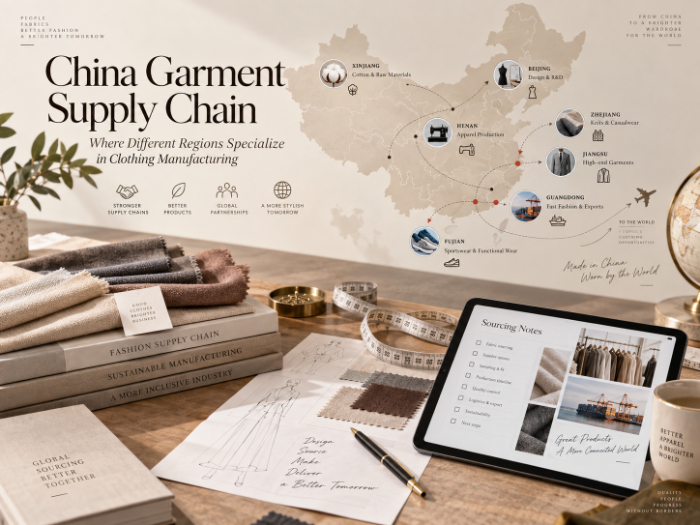
A finished garment may look like a simple product, but many production stages are involved before fabric becomes export-ready clothing.
The typical process includes:
Fiber → Spinning → Weaving/Knitting → Dyeing → Printing → Fabric Finishing → Trims → Design → Pattern Making → Cutting → Sewing → Finishing → Packing → Warehousing → Logistics → Export
If all of these suppliers were located in completely different regions, communication, transportation, and production costs would increase significantly.
Over decades, many Chinese garment-producing regions gradually developed a cluster model consisting of:
One core industry + surrounding supporting suppliers + professional markets + garment factories + logistics networks
China’s apparel industry organizations have long worked with dozens of garment manufacturing clusters nationwide and continue to promote specialized cooperation throughout the upstream and downstream supply chain.
This is why, in some Chinese garment manufacturing hubs, buyers can find all of the following within a relatively small area:
fabric markets, trim suppliers, printing factories, embroidery workshops, pattern-making companies, garment factories, packaging suppliers, and logistics providers.
For buyers, this high concentration of resources often means greater efficiency.

Zhejiang is one of the most important regions for understanding China’s garment supply chain.
The province has developed a highly integrated modern textile and apparel manufacturing system.
Key textile and garment areas include Xiaoshan, Tongxiang, and Keqiao, while Ningbo, Linping, Wenzhou, Haining, Xiangshan, and other locations have developed their own specialized sectors.
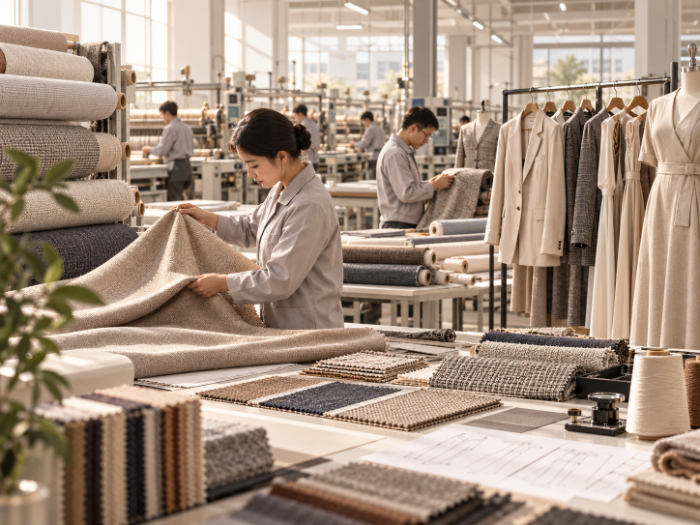
Keqiao’s greatest strength is not finished garment manufacturing alone.
Its biggest advantage is:
Fabrics.
The area has an enormous textile manufacturing and professional market ecosystem. Many Chinese garment factories visit Keqiao when sourcing fabrics for new collections.
A wide variety of materials can be found here, including:
Keqiao has also been investing in advanced manufacturing, digitalization, sustainable production, and fashion design.
For buyers who need to:
Keqiao offers major advantages.
Hangzhou and nearby regions have a strong foundation in women’s fashion, design, e-commerce, and brand development.
Compared with manufacturing regions focused mainly on large-volume basic products, this area is generally closer to:
fashion design, trend development, new-product creation, and e-commerce supply chains.
If your business focuses on fashion-driven womenswear with frequent style changes, Hangzhou and the surrounding Zhejiang supply chain are worth serious consideration.
Tongxiang is another important part of Zhejiang’s textile and apparel manufacturing cluster.
The surrounding area has a strong industrial foundation in knitwear and sweaters.
For buyers sourcing:
knit tops, sweaters, and autumn/winter knitwear,
the northern Zhejiang knitwear cluster can often provide more specialized expertise than a general-purpose garment manufacturing region.
Jiangsu is another major textile and garment manufacturing province in China.
Different cities within the province have very different specialties.
Shengze in Wujiang, Jiangsu, is one of China’s important textile manufacturing clusters.
The region has developed a complete industrial chain covering:
fiber, spinning, weaving, dyeing and finishing, garments, home textiles, and industrial textiles.
Shengze continues to advance digital manufacturing, flexible production, and textile supply-chain upgrading.
Its strengths are particularly strong in:
For this reason, many garment manufacturers producing woven and synthetic-fabric products maintain long-term sourcing relationships with suppliers in Shengze.
Changshu has a mature garment manufacturing industry and a large professional apparel market ecosystem.
A major characteristic of this area is the close connection between:
manufacturing + wholesale + professional markets + e-commerce.
This makes Changshu relevant for buyers looking for ready stock, wholesale apparel, and established garment supply-chain resources.
For many overseas buyers sourcing from China for the first time, Guangdong is one of the easiest garment supply chains to encounter.
The reason is simple.
Guangdong not only has a large number of garment factories, but is also connected to major commercial and export centers such as Guangzhou, Shenzhen, and Dongguan.
One of the region’s key advantages is:
fast market response, rapid style updates, and a highly commercialized supply-chain environment.
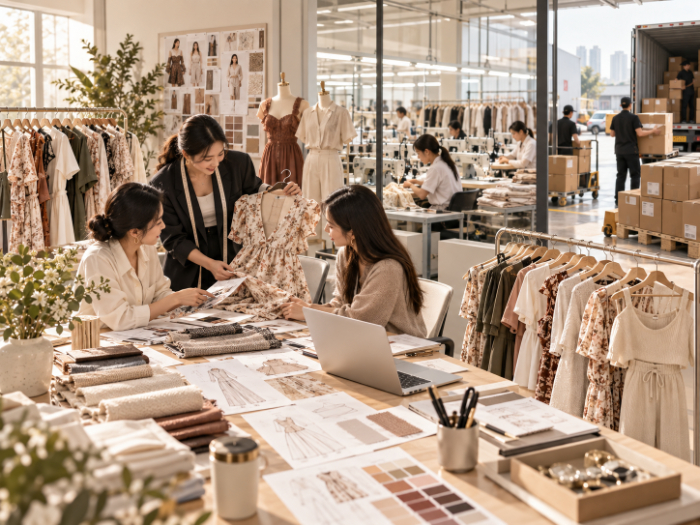
Guangzhou has numerous apparel markets, designers, supply-chain companies, and surrounding garment factories.
It is particularly strong in:
For buyers who frequently launch new products, test styles in the market, and then reorder successful items, the Pearl River Delta supply chain can be highly flexible.
Humen is one of Guangdong’s important apparel manufacturing bases.
The region continues to develop its garment industry through industrial parks, design resources, digital supply chains, and export services.
Its advantage is therefore not limited to manufacturing.
It also combines:
design, supply-chain resources, professional markets, and garment trading.
Shantou has a strong textile and garment manufacturing foundation, particularly in functional underwear, apparel, sourcing platforms, and professional textile markets.
For buyers sourcing:
underwear, loungewear, intimate apparel, and certain knitted products,
eastern Guangdong is another region worth considering.
Fujian has a very distinctive garment manufacturing profile.
The province has particularly strong industrial clusters in:
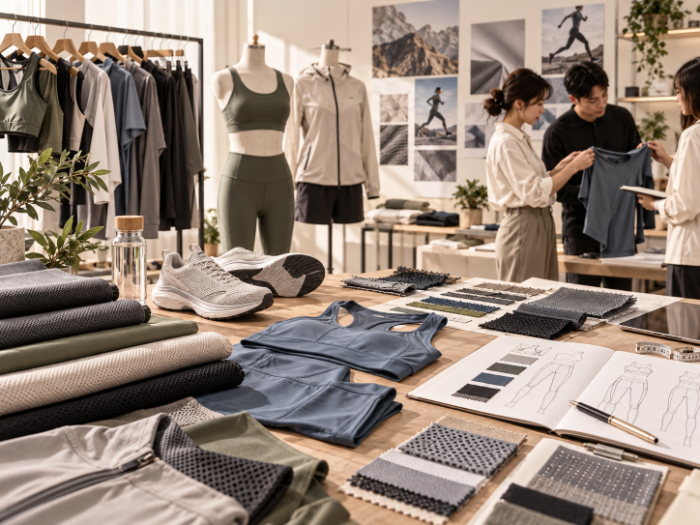
sportswear, casualwear, menswear, footwear, and related apparel supply chains.
Shishi is one of the representative textile and apparel manufacturing hubs in Fujian.
It has developed a complete industrial ecosystem covering:
raw materials and trims → weaving → dyeing → garment manufacturing → professional markets → e-commerce → export
The region has a strong foundation in casualwear, childrenswear, uniforms, and other apparel categories.
Shishi and the wider Quanzhou region are therefore particularly suitable for sourcing:
The region is also continuing to strengthen its global menswear supply-chain capabilities.
China’s garment supply chain is not concentrated only in the Yangtze River Delta and Pearl River Delta.
Northern China also has many specialized textile and apparel clusters.
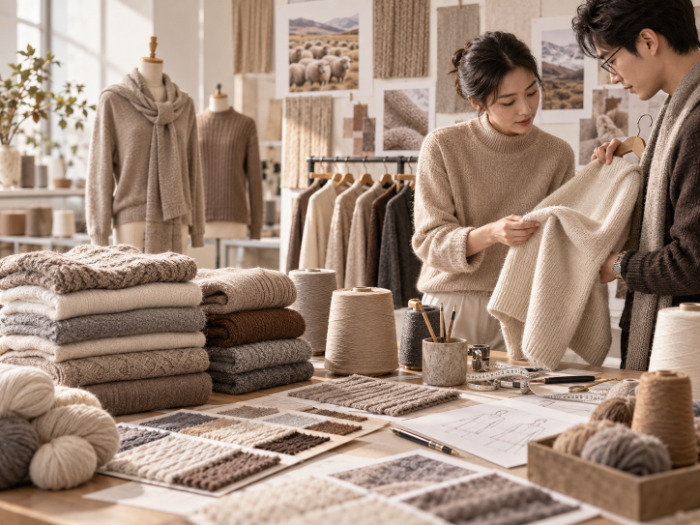
Historically, provinces such as Shandong and Hebei have developed long-standing expertise in textiles, cashmere, knitting, and other specialized sectors.
These regions are often not known for producing every type of garment.
Instead, their advantage is usually:
strong specialization in particular product categories.
For buyers, finding the right specialized manufacturing cluster can sometimes be more effective than searching through a large general-purpose apparel market.
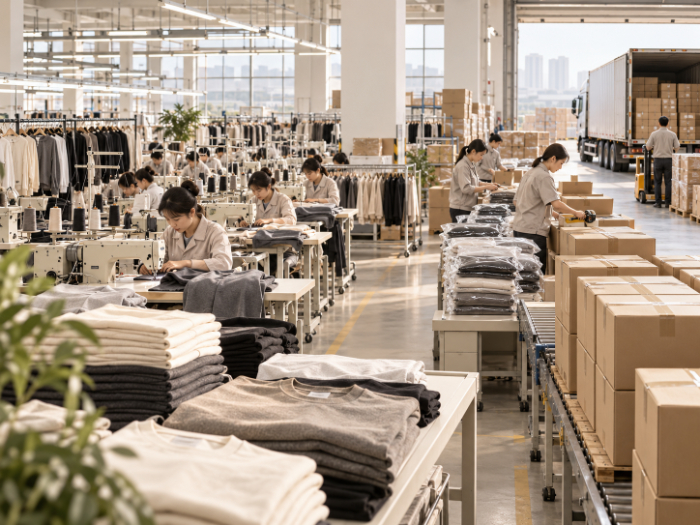
In recent years, one major change in China’s garment supply chain has become increasingly visible:
More manufacturing capacity is expanding into central provinces such as Henan, Anhui, Jiangxi, and Hubei.
This shift is driven by factors including:
labor availability, land costs, industrial relocation, and local manufacturing policies.
Central China is increasingly becoming integrated into the national textile and garment supply chain through industrial parks and regional manufacturing cooperation.
The main strengths of these areas are often:
competitive manufacturing costs and large-volume production capability.
However, some regions still rely on cooperation with mature eastern clusters for fabrics, design, trims, and rapid product development.
As a result, a common model in China’s modern apparel industry is becoming:
Eastern China for development + Central China for manufacturing + Nationwide supply-chain coordination
|
Region |
Main Strengths |
Best Suited For |
|
Shaoxing Keqiao |
Fabrics, printing, textiles |
Fabric sourcing, womenswear fabrics |
|
Hangzhou & surrounding areas |
Womenswear, design, e-commerce |
Fashion womenswear, fast-response development |
|
Tongxiang |
Knitwear |
Sweaters, knitted garments |
|
Shengze, Jiangsu |
Synthetic fibers, woven fabrics, weaving |
Synthetic and woven-fabric products |
|
Changshu |
Apparel markets, supply-chain resources |
Wholesale and garment sourcing |
|
Guangzhou |
Womenswear, fast fashion, professional markets |
Dresses, womenswear, sets |
|
Humen, Dongguan |
Garment manufacturing |
Womenswear, casualwear |
|
Shantou |
Knitwear, underwear |
Underwear, loungewear |
|
Shishi, Fujian |
Casualwear |
Menswear, sports casualwear |
|
Central China |
Production cost and volume manufacturing |
Basics and large-volume orders |
It is important to understand that this table is only a general guide to regional strengths.
Many large garment manufacturers now operate through cross-regional supply chains.
For example:
A factory may be located in one city, source fabrics from Keqiao, buy trims from Guangzhou, complete printing locally, and export the finished goods through Shanghai, Ningbo, Shenzhen, or Guangzhou.
Modern garment sourcing should therefore not focus only on:
“Where is the factory located?”
A more important question is:
“How strong is the supply chain behind this factory?”
After understanding China’s manufacturing clusters, buyers often ask another important question:
Do I always need to source from the most famous manufacturing hub?
Not necessarily.
If you are sourcing fabrics, choosing a specialized textile cluster can be extremely important.
But if you are buying finished garments, you should focus more on whether the factory has strong overall supply-chain management capabilities.
Here are several factors worth evaluating.
A factory that has specialized in loungewear for ten years will usually have very different experience from a factory producing loungewear for the first time.
The stability of bulk garment production often begins with the stability of the fabric supply chain.
For international brands, sample development speed directly affects product launch timelines.
A supplier that performs well with an order of 1,000 pieces may not necessarily be able to maintain the same quality and delivery performance when the order increases to 100,000 pieces.
The most important question is not whether production problems ever happen.
It is:
Can the factory identify problems before shipment?
For many wholesalers, the real profit does not come only from the first order.
It comes from being able to:
quickly restock products that are selling well.
In the past, many overseas buyers came to China primarily for one reason:
Price.
Today, however, China’s real competitiveness in apparel manufacturing increasingly comes from much more than low production costs.
It comes from:
complete supply chains + specialized industrial clusters + rapid product development + large-scale manufacturing capacity + flexible replenishment
Supply-chain completeness, market responsiveness, professional services, and digital capabilities are becoming increasingly important competitive factors.
This is one reason why China continues to play a major role in the global garment supply chain even as apparel manufacturing expands to more countries around the world.
If you plan to source garments from China, do not begin by comparing quotations from thousands of factories.
Start by answering three questions:
What product do I want to make?
What type of fabric do I need?
What is my expected order volume?
Then look for factories that are connected to the right manufacturing cluster and supply chain.
This approach is often far more effective than simply searching for the supplier offering the lowest price.
ELEVIE GARMENTS specializes in the manufacturing and wholesale production of women’s loungewear, casual sets, sportswear, dresses, and women’s pants.
For overseas customers, we provide more than finished garment manufacturing. Depending on the product requirements, we can support:
Fabric Selection → Sample Development → OEM/ODM → Bulk Production → Quality Control → Packaging → Reorders
Our goal is not simply to manufacture one batch of garments.
Our goal is to help customers build a more stable and efficient garment supply chain in China.